

Standards often teach poultry keepers to look for consistency: the same comb, the same feather pattern, the same recognizable outline. An Icelandic flock challenges that expectation. Birds can differ visibly without the flock’s diversity being a breeding mistake.
The key word is landrace. The Livestock Conservancy describes Icelandic chickens as a population selected for useful farm traits rather than conformity to one visual standard. Their history is associated with the Norse settlement of Iceland and generations of life on smallholdings.
Variation belongs in the account
The Conservancy records different feather colors and patterns, single and rose combs, and the presence or absence of a crest. It also describes active foraging and retained mothering behavior. These characteristics help explain why a single glamorous rooster cannot serve as a complete portrait of the population.
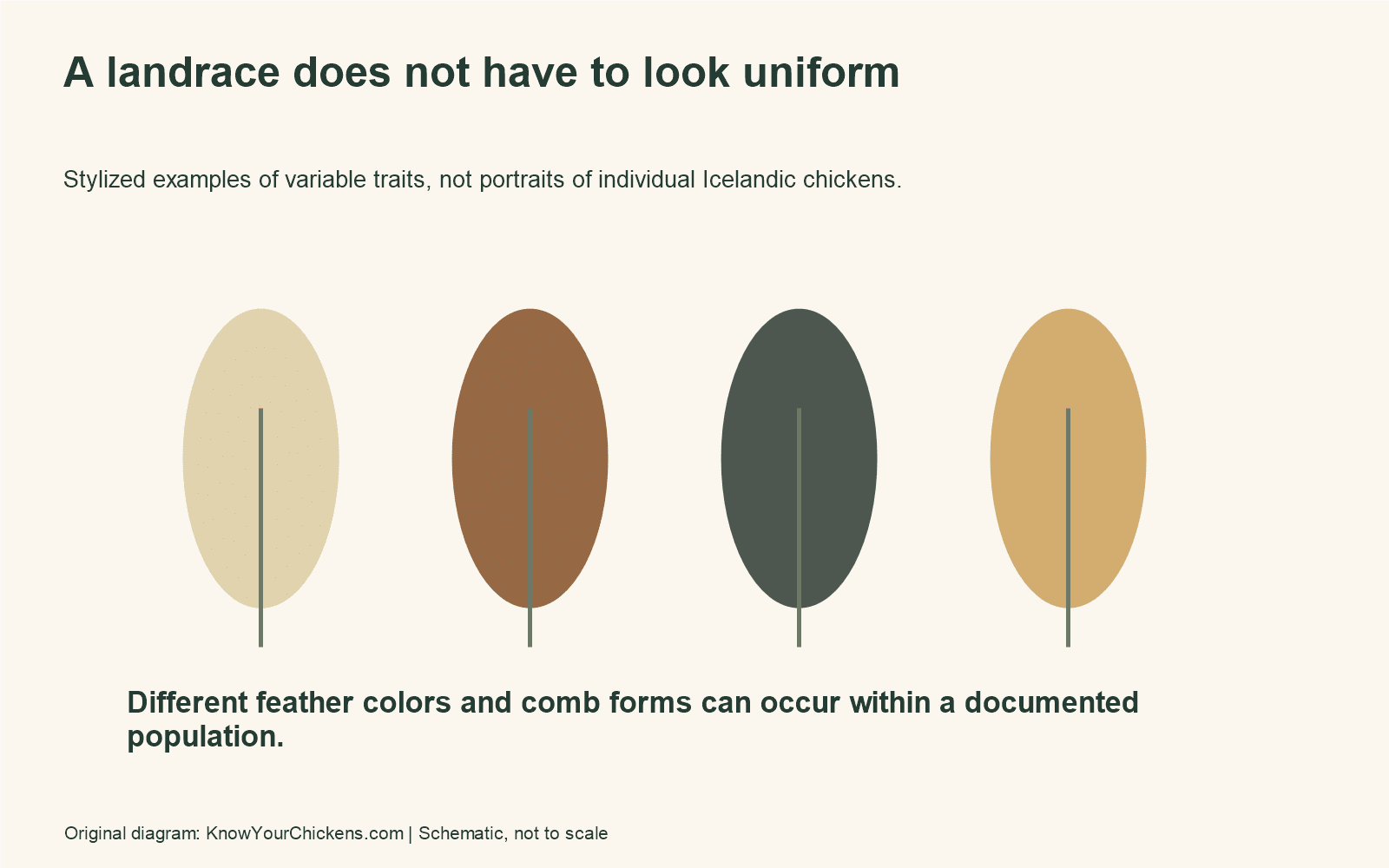
There are still limits to the description: the account specifies unfeathered legs and excludes beards, muffs and ear tufts. “Variable” does not mean every trait or every chicken belongs. Nor does a bird become Icelandic simply by looking unlike its flock mates.
Ancestry matters when appearance varies
For a keeper interested in conservation, the useful questions concern the source flock and its breeding history. Where did the birds come from? Has outside stock been introduced? What records accompany the eggs or chicks? Those questions address the population being conserved, something a color photograph cannot establish.
Our Swedish Flower Hen article offers another encounter with landrace diversity, while the breed overview shows how different poultry categories can be. A visually mixed flock and a documented landrace can both contain varied birds, but the terms describe different histories.
The practical appeal of an Icelandic flock is therefore broader than collecting several colors. It is an opportunity to keep a population whose identity does not depend on making every bird match one exhibition portrait. Observe the differences, preserve the source information, and let the history explain why uniformity is not the only meaningful goal.


