

A chicken’s chest can move as it breathes, yet its lungs do not inflate and deflate like ours. The moving parts and the gas-exchanging parts of the system do different jobs. That is the detail a mammal-shaped mental picture tends to miss.
In humans, air enters branching passages that end in alveoli, where gases are exchanged with the blood. Air then travels back out along the airways. In birds, relatively rigid lungs work with a system of air sacs that move air through them.
The bellows are not extra lungs
University of Kentucky’s avian anatomy resource describes the air sacs as bellows. The lungs contain small passageways called parabronchi, associated with the blood vessels where gas exchange occurs. The distinction is between moving air and extracting oxygen from it.
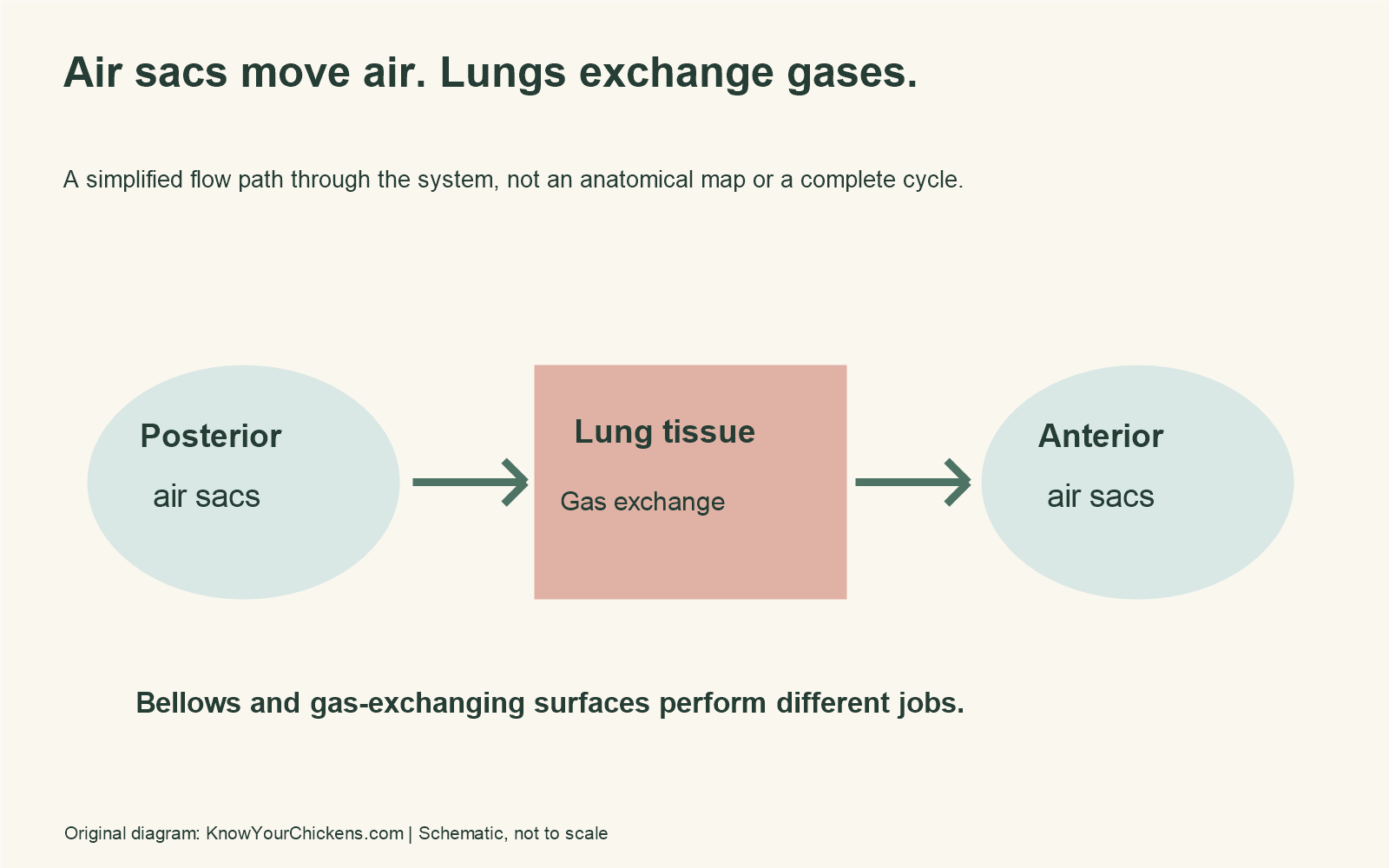
The simplified diagram shows a direction of flow through the system. It does not mean that three isolated containers sit in a straight line inside the bird. The real network is three-dimensional, and air sacs occupy different regions of the body.
A breath is part of a longer journey
AkoVet’s poultry anatomy explanation follows a portion of air across two inhalation–exhalation cycles. In the simplified sequence, fresh air reaches posterior sacs, passes through the lungs, moves into anterior sacs and then leaves. Meanwhile other air is already moving through other parts of the system.
This is why the phrase “one-way airflow” needs a location attached to it: it describes flow through the gas-exchanging lung passages, rather than claiming that the beak is a one-way entrance. Air still has to enter and leave the bird. Nor does it mean the bird takes one breath, pauses while using it twice and only then breathes again.
Some bones connect with the air-sac system, a feature called pneumatization. That does not mean every bone is an empty breathing tube. Our beak-and-digestion article considers another place where a familiar external part hides a more specialized arrangement inside.
The coop is part of every breath
The University of Kentucky resource also describes mucus, cilia and defensive cells that help clear inhaled material. Dust and poor air conditions can challenge those defenses. Air sacs are not a reason to treat every sneeze as the same disease; they explain why the bird’s environment deserves attention alongside the bird.
Our sneezing article separates possible contexts, and coop planning considers the space producing that air. Persistent breathing difficulty needs prompt veterinary attention. The anatomical lesson is useful even in a healthy flock: a chicken’s lungs are one component of a larger ventilation system, with air sacs doing the bellows work that expanding mammalian lungs help us perform.


