

Watch a chicken walk past a fence and the head seems to pause while the body catches up. Then the head advances quickly and pauses again. The familiar head-bob is not simply a miniature human nod repeated with every step.
Work on locomotion and head movements in chicks describes head bobbing as an optokinetic response linked to movement of the visual scene across the retina. The stable-looking phase and the rapid forward movement are parts of a coordinated sequence.
A stable interval helps explain the illusion
When the body advances during a hold phase, the head can remain relatively stable against the surroundings. Viewed from the bird’s moving body, that is a different movement from the one recorded by a stationary camera. Following the fence in the background makes the distinction easier to notice.
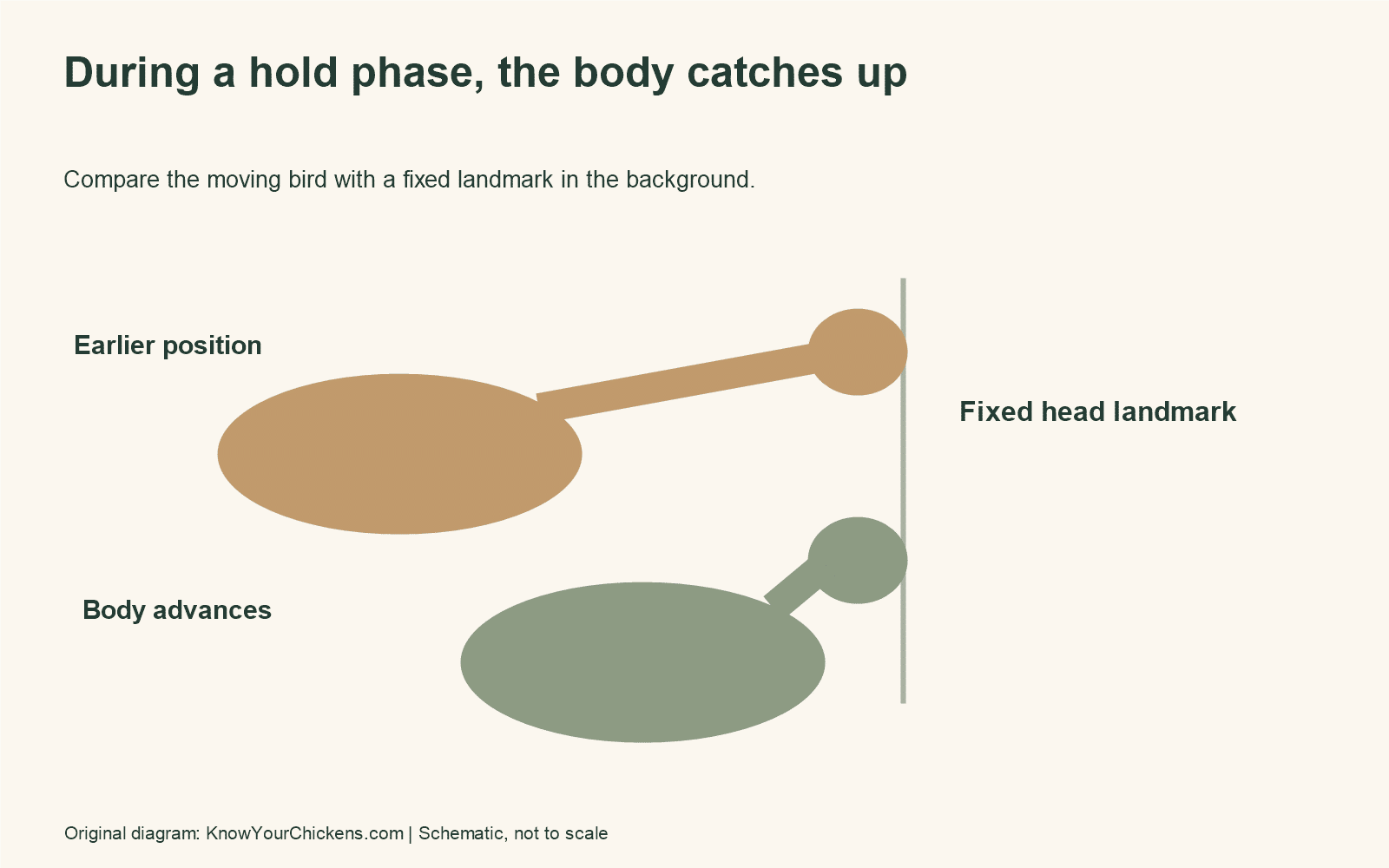
The diagram uses fixed landmarks to illustrate the concept. It does not claim that a head is motionless in all directions or that every step has identical timing. Speed, terrain and the bird’s activity can change the visible pattern.
A walking bird is doing more than moving its legs
Vision and movement are connected. Our chicken-vision article explains why head position matters when observing a bird’s view of its surroundings. It also distinguishes a human camera image from a literal reconstruction of what the chicken sees.
Do not reproduce viral demonstrations by repeatedly lifting, shaking or moving a bird to test how stable its head remains. Ordinary walking gives ample opportunity to observe the sequence without restraint.
The contrast is what makes the movement memorable: the body travels steadily while the head’s visible motion is broken into different phases. Looking at both against a fixed background turns a funny-looking gait into an interesting example of vision working with locomotion.


