

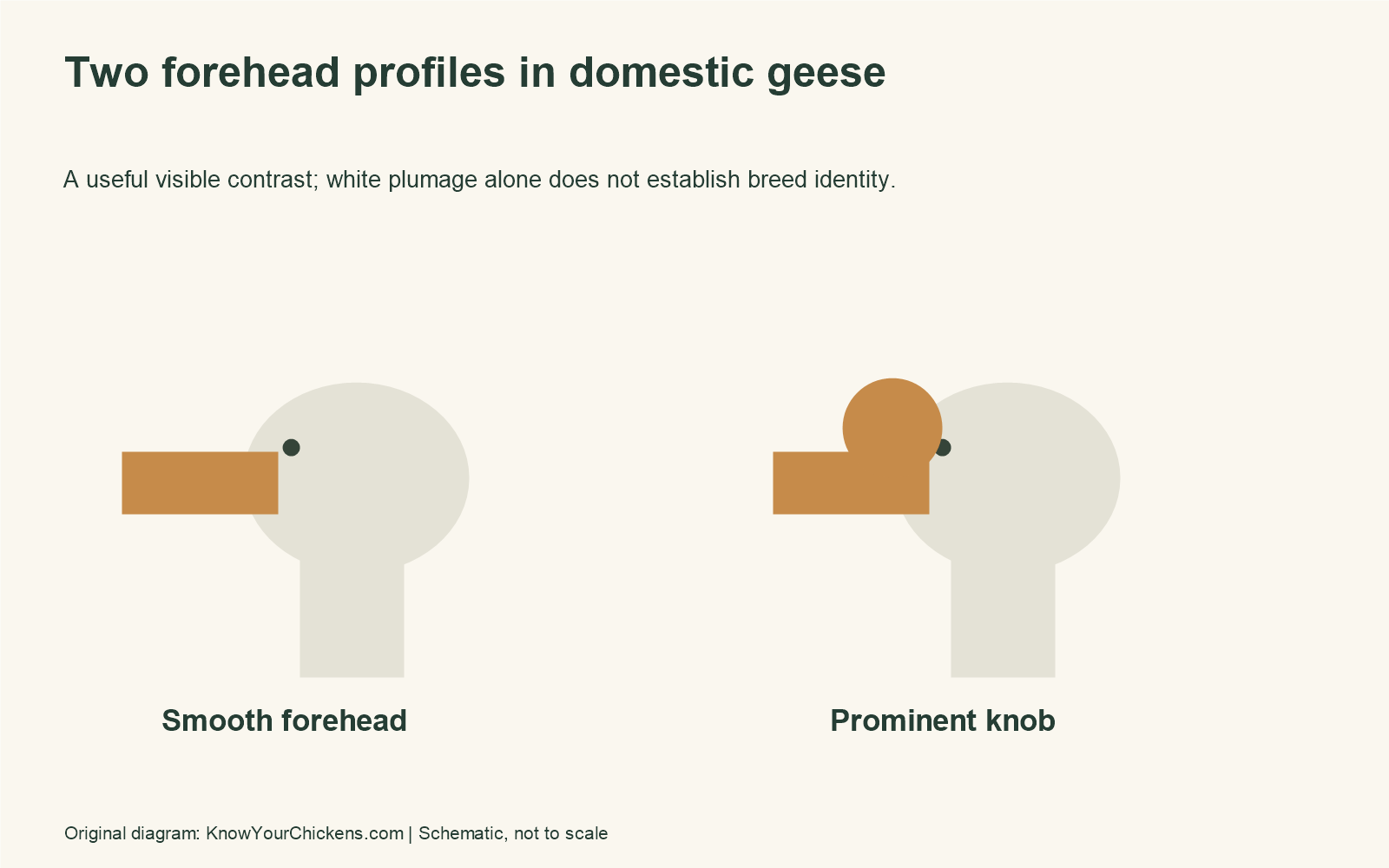
The forehead knob makes a Chinese goose’s profile immediately distinctive. It sits above the bill and belongs to a bird with a long, curved neck—a very different outline from the heavy white goose many people first picture on a farm.
The Livestock Conservancy traces Chinese geese to the Asian swan goose. Brown and White varieties were recognized in the American standard in 1874. In Brown birds, the dark bill and knob contrast with the face; White birds have orange bills and knobs.
Compare birds of known age
A mature breeding-bird portrait should not become the expected appearance of every gosling. Development and individual variation matter when evaluating an external feature. Ask about age and background before interpreting photographs from different flocks.
A knob alone is also not a dependable way to settle every sex-identification question, especially in young or crossed birds. A breeder should explain the method used and its limits rather than relying on a picture of one prominent feature.
The feature needs protection too
The Conservancy specifically notes that the knob is vulnerable in freezing conditions. The relevant care decision concerns exposure and shelter, not simply a reputation for hardiness. Observe the individual bird and obtain veterinary advice for suspected cold injury.
Our mixed-animal article considers sharing a property with hens, while the waterfowl-and-chicken discussion highlights why wet areas and resources need planning. A watchful goose is not a substitute for predator protection, and its own welfare remains part of the arrangement.
The smooth-versus-knobbed comparison in the diagram is useful as one visible contrast. For an actual Chinese goose, combine that outline with age, variety, documented origin and the rest of the bird rather than treating the knob as its whole identity.


