

On a black Minorca, the bright white earlobes create a striking contrast with the red face and comb. They are among the features that make the breed recognizable, but they are only one part of a large, active Mediterranean laying bird.
The Livestock Conservancy associates the name with the island of Minorca while noting that the breed’s exact earlier origin is uncertain. That is a more accurate starting point than presenting a speculative Roman or Moorish route as settled history.
The white patch is an earlobe
An earlobe is external tissue near the ear region; it is not an exposed eggshell-making organ. Many breed descriptions connect white earlobes with white eggs, and Minorcas do lay white-shelled eggs. That association should not be promoted into an exceptionless rule for all chickens. Our egg-color guide explains why breed context matters.
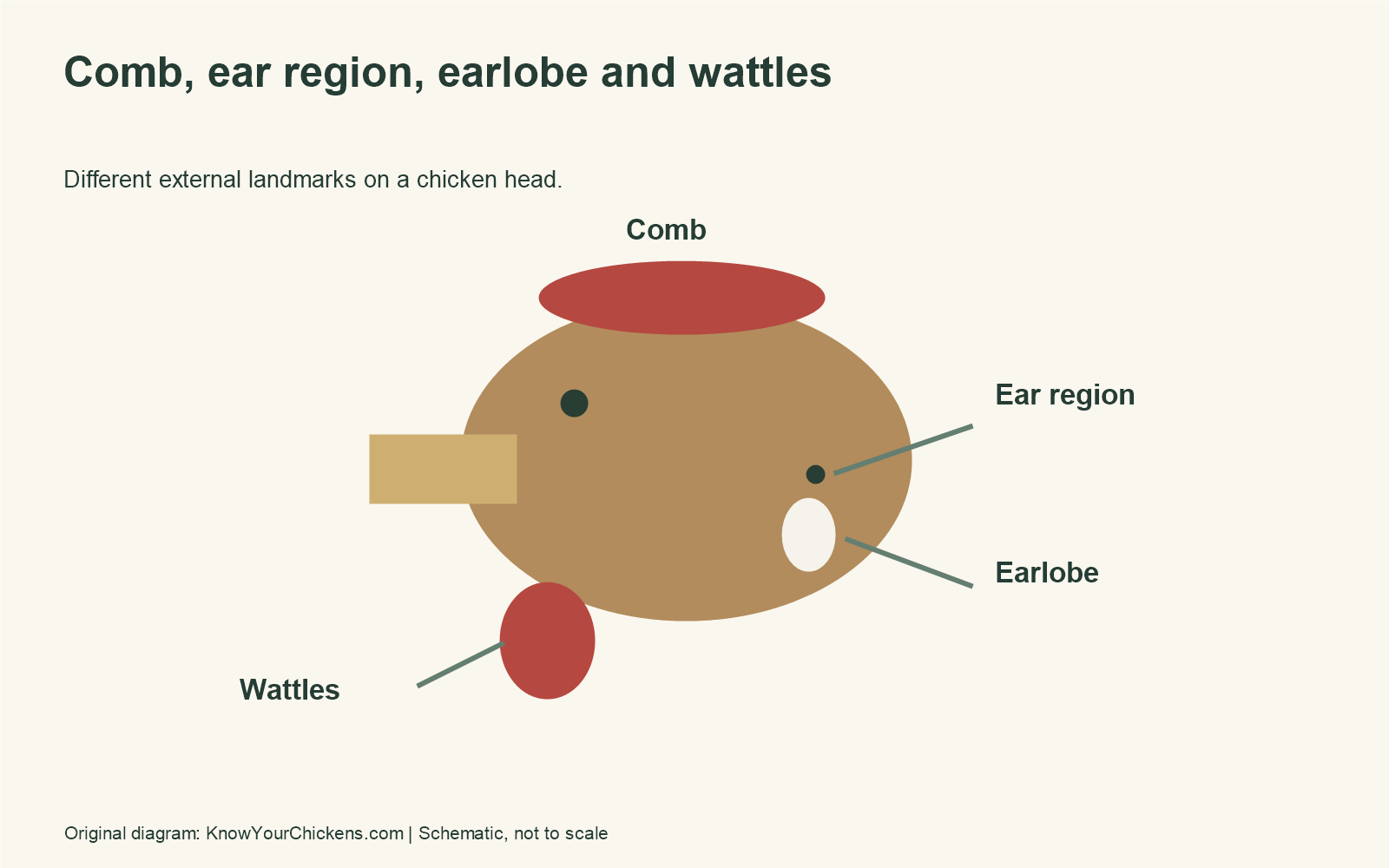
Look at the whole head in good light. The comb, wattles and earlobes occupy different positions, even though photographs can make the patches overlap visually. The diagram separates those external landmarks.
Large and active are compatible traits
A Minorca’s relatively substantial frame does not make it a slow-moving equivalent of every heavy breed. The Conservancy describes an active bird that likes to range. A keeper should evaluate available movement and secure boundaries as well as adult size.
The prominent comb also belongs in a climate decision. Our cold-weather article discusses exposed combs and winter care; a breed’s Mediterranean association is not a thermometer reading or a guarantee that a particular coop is suitable.
For someone interested in Minorcas, the useful breeder conversation covers adult type, activity, egg records and the conditions in which the line is maintained. Compare that with the reasons for choosing a Leghorn, another familiar white-egg breed with a different type. The Minorca’s white earlobes may start the conversation, but they should not make the rest of the bird disappear.