

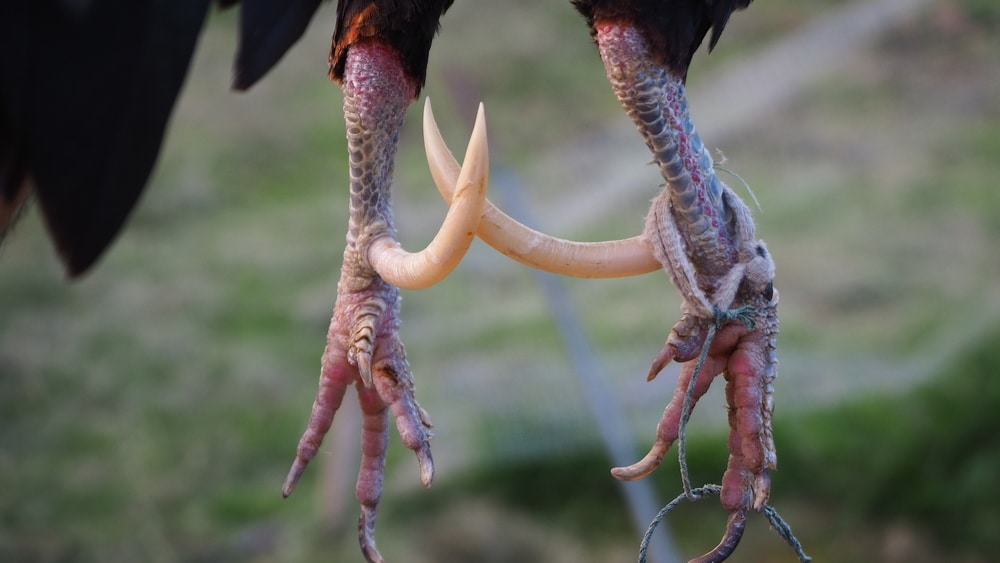
Rooster spurs are pointed structures that grow from the lower leg. Their size and shape vary with age and the individual bird; some hens can develop spurs too. A spur is not just a harmless nail to remove at will: its hard outer covering protects living structures, and damage can be painful and bleed.

Decide what problem you need to solve
A long spur is not automatically a problem. Inspect whether it catches on objects, rubs the rooster’s leg, grows toward the skin, or causes injuries during mating or handling. An aggressive rooster also needs behavior and access management; shortening a spur does not make the bird safe around children.
For a bird that is limping, bleeding, or has swelling at the spur base, arrange veterinary assessment. A cracked spur or injury can need care even when its length looks ordinary.
Avoid hot-potato and twisting methods

Do not soften a spur with a microwaved potato and twist the sheath off with pliers. Heat can burn the leg, and forced removal can expose or damage living tissue. Calling a method traditional or tool-free does not make it a safe home procedure.
If spur length needs managing, ask a poultry or avian veterinarian to assess it and demonstrate any appropriate maintenance. The safe amount depends on the structure, shape, and bird; a fixed length or a picture online is not a reliable guide for cutting. Do not use wire cutters to take off an arbitrary section.
Reduce avoidable injuries around the flock
Provide enough room and escape routes so hens are not repeatedly cornered. Observe mating and check the same hens for damage rather than assuming that the rooster-to-hen ratio alone prevents it. Roosters differ in behavior, and a number on a chart cannot replace observation.

Review flock introductions when aggression begins after a new arrival. Keep visitors and children out of contact with a rooster that challenges people. Do not try to establish dominance by hanging the bird upside down or provoking repeated confrontations.
Handle and inspect calmly
Use secure, gentle restraint that supports the body without restricting breathing, and get experienced help if you cannot manage the bird safely. Check feet, gait, body condition, and the leg around the spur during routine observation. The bumblefoot guide covers another reason a rooster may avoid walking normally.
If you are trying to identify a young bird’s sex, spur development is only one clue and may be late or misleading. Use the hen-versus-rooster guide and allow for breed and age differences rather than deciding from a small bump on the leg.
Treat a human scratch as an injury
Clean a scratch or puncture promptly and seek medical advice for a deep, contaminated, infected, or otherwise concerning wound, including questions about tetanus protection. Keeping poultry equipment and handling areas hygienic reduces exposure but does not make a wound risk-free.
Keep the management goal specific: prevent catching, pressure, or injuries while protecting both people and the bird. Routine painful removal is not a substitute for a suitable enclosure and safer flock interactions.


