

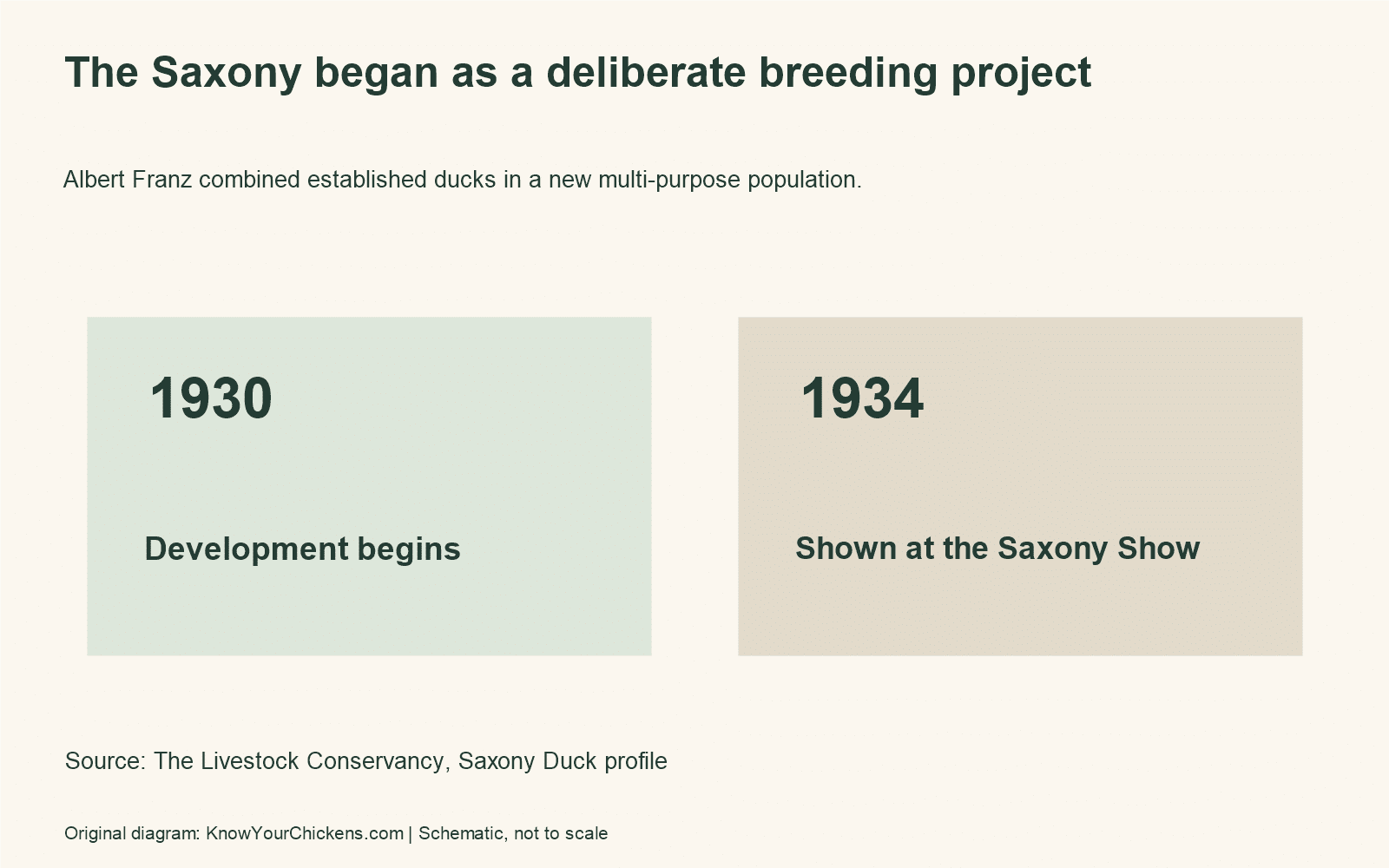
The Saxony’s colors belong to a deliberate breeding project rather than a chance assortment of attractive ducks. Albert Franz began developing the breed in Germany in 1930, using Rouen, German Pekin and Blue Pomeranian birds.
According to the Livestock Conservancy’s account, the new duck was shown at the Saxony Show in 1934. The aim combined exhibition appeal, eggs and meat. Those origins help explain why the modern breed is substantial as well as decorative.
Color sits on a heavy body
The adult drake and female have different color patterns. A breeding flock should be assessed as mature birds of known sex and background, rather than assuming that one photograph represents every Saxony at every age.
The Conservancy lists drakes around eight to nine pounds and females around seven to eight pounds. Individual lines vary, but those figures put the bird firmly into a practical discussion of space and access. Our large-duck article considers those implications beyond appearance.
A breeding history can be checked
Ask where a flock came from, how birds have been selected and which records accompany them. It is reasonable to expect a breeder to distinguish documented ancestry from a resemblance. A duck with similar colors is not automatically a Saxony, just as the breed’s crossbred development does not mean every later cross belongs to the standardized breed.
For someone keeping ducks as companions, a breed history adds interest without replacing daily care. The feeding guide covers life-stage needs and the pet-duck discussion considers the longer commitment.
The timeline is the memorable part of this story: a named breeder set out to combine useful traits, drew on several established ducks and presented a new population. The colors are an entry point into that history, rather than the only reason the bird exists.