

An egg can look spotted because of color, because its surface is raised, or because both are happening together. The chalky bump you feel with a fingertip is a different observation from a flat brown mark on the shell.
That distinction is useful before calling every irregular egg “speckled.” The shell has been built in the hen’s reproductive tract, and extra material on its outside can record a disturbance during that construction.
More mineral in one place
University of Georgia Extension’s account of egg abnormalities describes excess calcium deposits and smaller, rough pimples. Disturbed calcification, shell-gland problems and dietary factors can be involved. Their appearance does not, on its own, prove that the hen needs another calcium supplement.
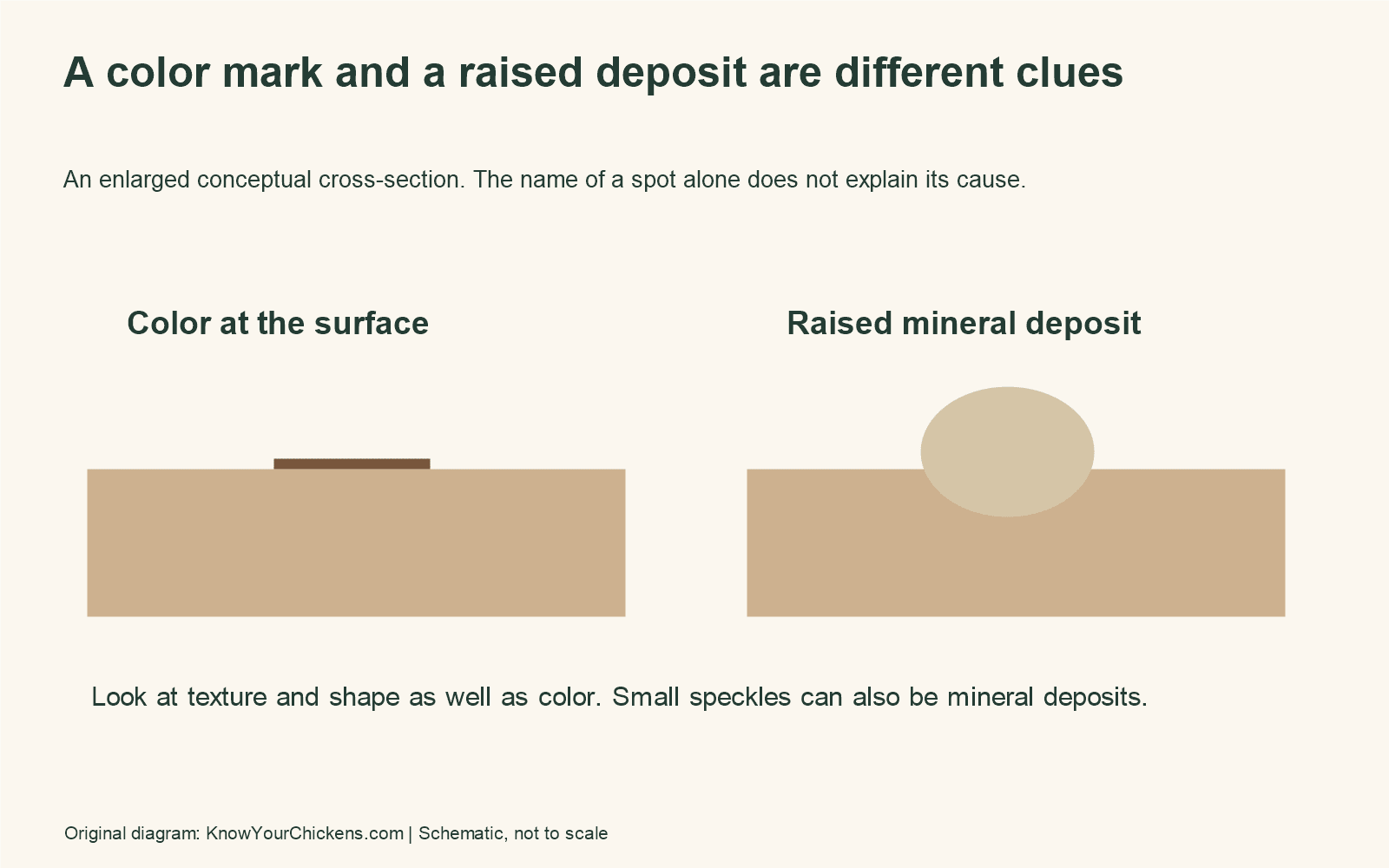
UGA also notes that some small white or brown speckles are themselves mineral deposits. So “speckle” and “calcium deposit” are not completely separate categories. Texture helps describe the egg more accurately; it does not provide a laboratory result from a kitchen inspection.
A shell has more than one kind of quality
A raised bump, a crack and a thin patch are different findings. Photographing the unusual egg beside a typical egg from the same hen can make a later conversation more useful. Note whether the roughness appears once, on every egg from one bird, or across several hens at roughly the same time.
Our calcium discussion explains the role of a balanced diet, while the laying-cycle article gives context for the process behind each egg. Adding supplements whenever a shell looks unusual can obscure that larger picture.
A small surface oddity also cannot certify the condition of the egg inside. Ordinary collection and storage practices still apply. The interesting clue in a chalky bump is the extra material itself: describe its relief, extent and recurrence before trying to turn its color into a diagnosis.


