

A blue-gray Swedish duck can look as if it has dipped its chest into white paint. The bib is a conspicuous part of the breed’s appearance, set against a darker body and head. It gives the eye a clear landmark even when the bird is moving.
The Livestock Conservancy traces foundation blue ducks to Pomerania in 1835, then part of the Kingdom of Sweden and now divided between northeastern Germany and northwestern Poland. The name reflects that historical setting; it does not mean every stage of development occurred within Sweden’s present borders.
A bib and a body color are different features
The pale breast marking should be considered separately from the blue dilution affecting the body plumage. Blue breeding groups can also produce black and splash offspring. The general inheritance principle is explained in our blue-dilution article; repeating the whole probability grid here would hide the Swedish duck’s own story.
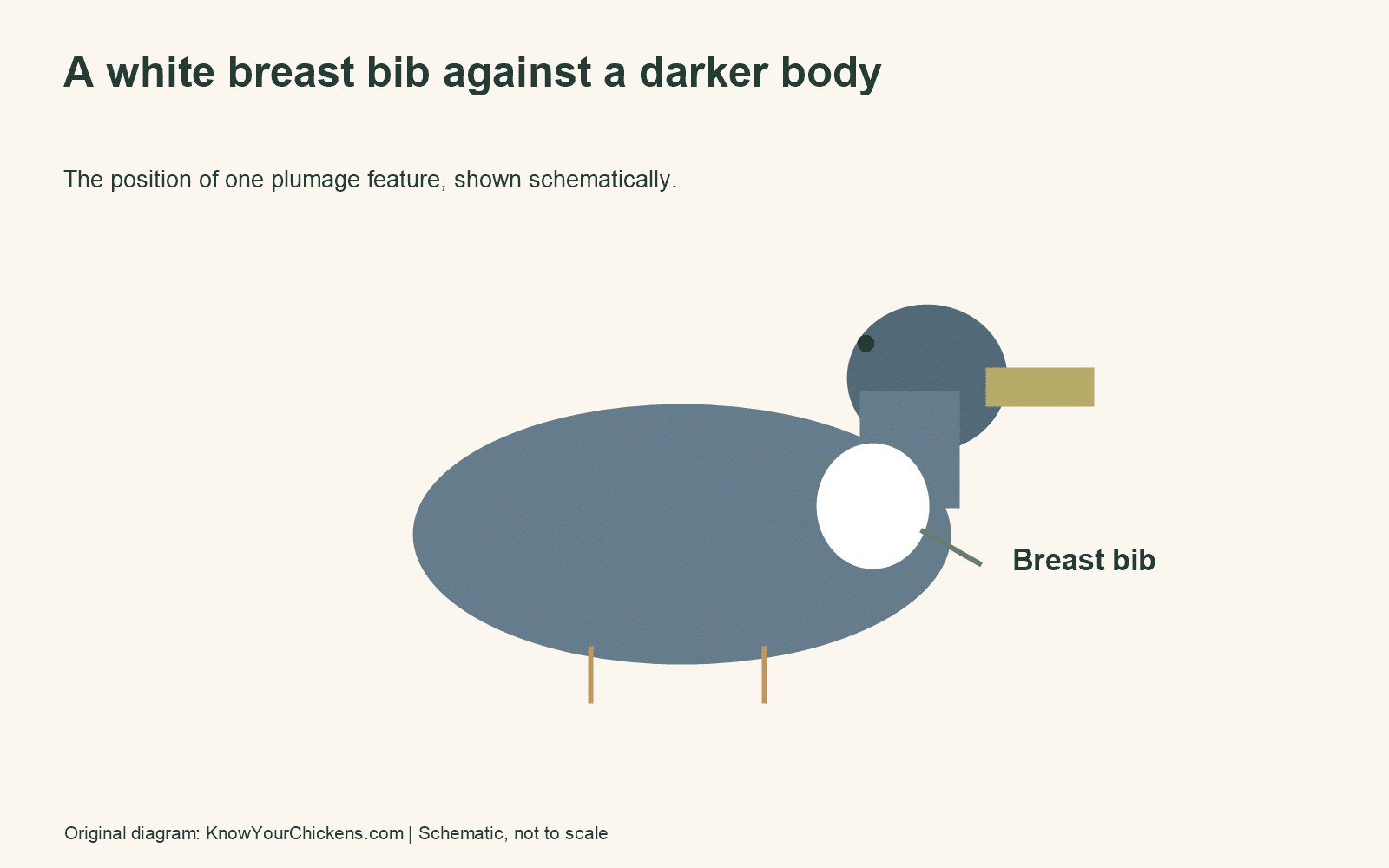
The schematic shows where a bib sits on a duck’s body. It is not an exact color standard, and a white chest marking alone does not prove that a bird is a purebred Swedish. Crossbred ducks can carry recognizable-looking markings too.
Ask about the adult flock
Look at mature birds rather than choosing only from duckling color. Ask the breeder what varieties occur, which birds belong to the breeding group and what records accompany them. A photograph should identify the bird and age rather than imply that every youngster will grow into the same outline.
Our domestic-duck overview places Swedish ducks among other breeds, while feeding guidance addresses the practical life-stage needs shared across a properly managed flock. The white bib is a memorable visual detail; understanding its place within a documented domestic breed makes the description more useful than the marking alone.