
The same corner goes dark after every downpour. Fresh material hides it for a while, then the puddle returns. That repeating patch is a useful map: something about the water’s route or the ground’s ability to drain keeps bringing the problem back to this spot.
Before choosing another surface material, watch the next rainfall from outside the run. Water may be arriving from a roof edge, traveling downhill from a path, collecting in a depression, or overflowing a nearby container. Each route suggests a different problem. A photograph taken after everything is already wet often loses that distinction.
Follow the arrival, not only the puddle
The British Hen Welfare Trust discusses drainage and shelter in managing muddy runs. The relevant principle is that a floor covering and a water source are separate parts of the situation. Covering the surface does not necessarily change where runoff lands.
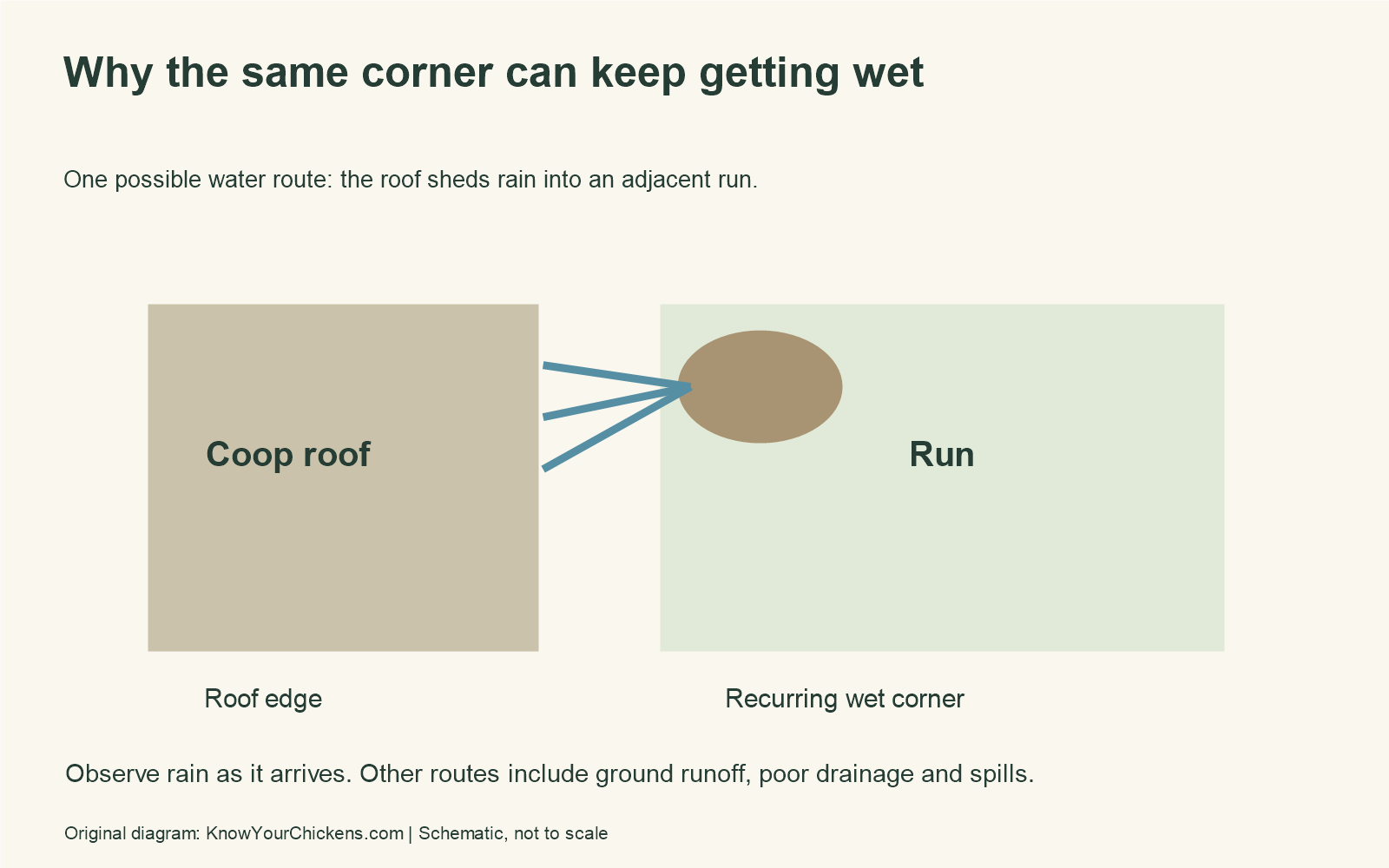
For example, a roof can protect the center of an enclosure while shedding water along its edge. If that edge empties into the busiest corner, the roof has moved the rainfall rather than removed it from the site. Similarly, a drinker spill can produce a wet patch in weather that is otherwise dry. Our waterer discussion helps connect the equipment to that observation.
Traffic can keep the patch exposed
A gate, feeder or narrow passage concentrates feet. Repeated use can remove vegetation and disturb the surface, making the wet area conspicuous even when the rest of the run looks reasonable. Note whether the location is also where birds have to stand to reach food or enter shelter.
The answer is not automatically a deep hole filled with an arbitrary aggregate. Existing soil, drainage routes, utilities and the effect on neighboring ground need consideration before excavation. For a persistent site problem, local drainage advice is more useful than an exact material depth copied from a different garden.
The bedding system cannot absorb an unlimited supply
Keep outside runoff distinct from moisture management inside the coop. Our deep-litter article concerns a managed bedding system; it is not a promise that more dry material will make flowing water disappear. The coop-design discussion also starts with the building and its location, not just its appearance.
The revealing observation is what happens when water first arrives. Once you know that route, you can assess whether a change actually interrupts it. A dry-looking layer on top of the same returning puddle answers a much smaller question.