
A winter coop can feel sheltered when you close it for the night, then greet you with droplets on the inside of the windows the next morning. That small change deserves attention. The glass is showing you something the thermometer cannot: moisture has reached a surface cold enough for water to collect.
It is easy to read that wet window as evidence that the birds need more warmth. Before adding heat, there is another question to answer: where is the water coming from, and how is it supposed to leave?
The window is a cold surface, not a humidity meter
Condensation forms when a surface is cold enough relative to the dew point of the surrounding air. Think of droplets on the outside of a cold drinking glass. In a winter coop, the cold surface may be the inside of a window or an exposed part of the roof.
The EPA’s moisture-control guidance notes that indoor window surfaces are often colder than nearby walls and can be the first places where winter condensation becomes visible. That is building physics, not a diagnosis specific to chickens.
Consequently, two coops with similar indoor air can look different if their glazing and surface temperatures differ. A wet pane does not give you an exact relative-humidity reading. A dry pane does not prove the litter is dry or the air exchange adequate. The useful observation is the whole scene: glass, roof underside, bedding, waterer and the birds’ resting area.
Closing the coop does not stop moisture arriving
The hens are still breathing, manure is still accumulating, and a leaking drinker can keep adding water to the floor. A coop can exclude rain and still have a moisture problem inside.
University of Minnesota Extension recommends controlling moisture through both manure management and ventilation. It specifically identifies moisture collecting on windows or objects, along with ammonia odor, as reasons to improve air exchange and clean up manure.
Those two jobs work together. Opening a vent does not repair a dripping drinker, and covering a saturated patch with clean bedding leaves the water underneath. Where a litter system is involved, our deep-litter article explains why accumulated material still needs inspection and intervention.
An air route above the birds is different from a draft across them
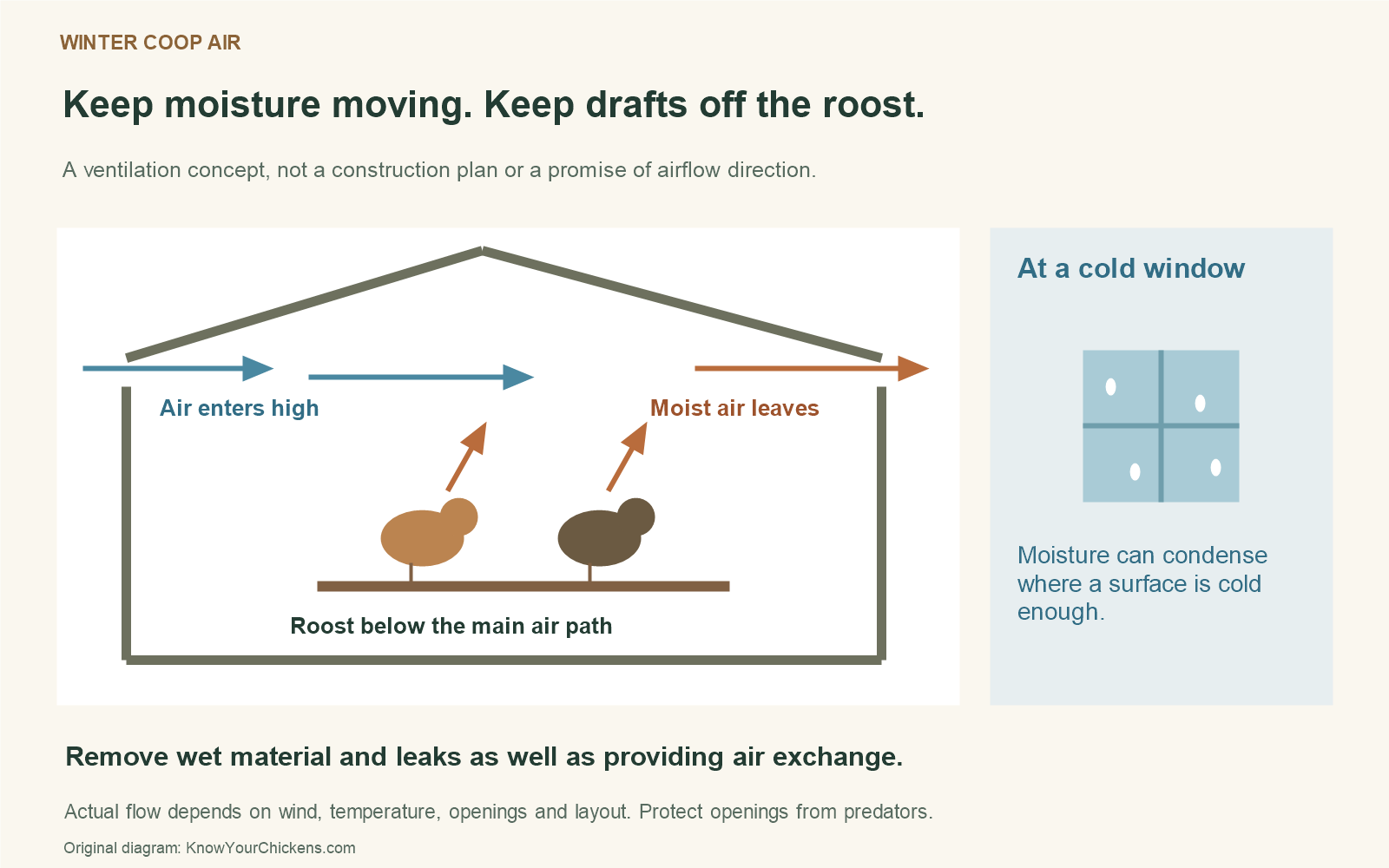
The goal is air exchange that carries moisture out while avoiding a cold stream directly over resting chickens. A hole beside the perch and a protected opening high in the structure can produce very different conditions at bird level.
In its explanation of winter poultry-house ventilation, Poultry Extension describes incoming air warming as it moves into the building and the need for an exit route for moisture-laden air. Ventilation requires a route through the space; an opening that has been covered with plastic cannot perform its original job.
The diagram shows a principle, not a vent-size prescription. Wind exposure, temperature differences, flock size and the shape of the building affect the result. Any opening also needs appropriate protection from predators. Changes should be judged where the birds sleep, not only by how comfortable the doorway feels to a person standing there.
The pattern over several mornings is more useful than one photograph
Consider two observations. Droplets spread across the inside of the glass after a cold, dry night suggest a different investigation from a wet streak below one roof joint after rain. The first fits a condensation pattern; the second raises the possibility of a leak. Neither observation rules out both problems occurring together.
A photograph taken from the same position each morning, with a note of overnight weather, can make a recurring pattern easier to see. Add a note about wet bedding or drinker spills. These are observations to compare, not a humidity score or a substitute for checking the flock.
A temperature-and-humidity instrument can add context, but its reading belongs to its location. A sensor beside a cold window should not automatically be treated as a description of every perch. There is no need to invent a single humidity percentage that guarantees safety in every coop.
More heat is a separate decision
Supplementary heat may be appropriate for particular birds or conditions, but it is not a replacement for removing wet material and providing air exchange. Equipment choices belong in our coop-heater guide; breed and individual differences are covered in cold-hardy chickens and winter care.
The next morning’s useful question is not simply whether the window has cleared. It is whether the bedding and resting area are staying dry, the moisture sources have been addressed, and the birds have shelter without a direct draft. The glass is one clue in that picture, not the whole inspection.