
Chicken eggs usually take about 21 days to hatch. A successful incubation depends on stable conditions, suitable humidity and ventilation, turning during development, and careful handling. Use the calendar below with the incubator’s own instructions: still-air and fan-assisted machines do not have identical temperature requirements.

Before day 1: test the setup
Run the empty incubator long enough to establish stable conditions. Position measuring equipment where the manual specifies and check the display against appropriate independent instruments. Put the machine away from direct sun, drafts, and fluctuating room temperatures.
Many forced-air chicken protocols use about 99.5°F (37.5°C); still-air machines generally require a higher reading at the specified egg level. This is not a reason to treat every value between 99°F and 102°F as interchangeable. Maine Extension explains the machine-type distinction. Follow the model’s instructions for humidity and sensor placement too.

Setting day
Use sound fertile eggs and load them in the orientation the tray or turner requires. Record the setting time, number of eggs, source, target conditions, and any calibration adjustment. Do not force oversized eggs into a tray or obstruct airflow to reach the advertised capacity.
If you have not yet chosen a method, the broody-hen versus incubator guide covers the earlier planning decisions.
Early development: turning and observation
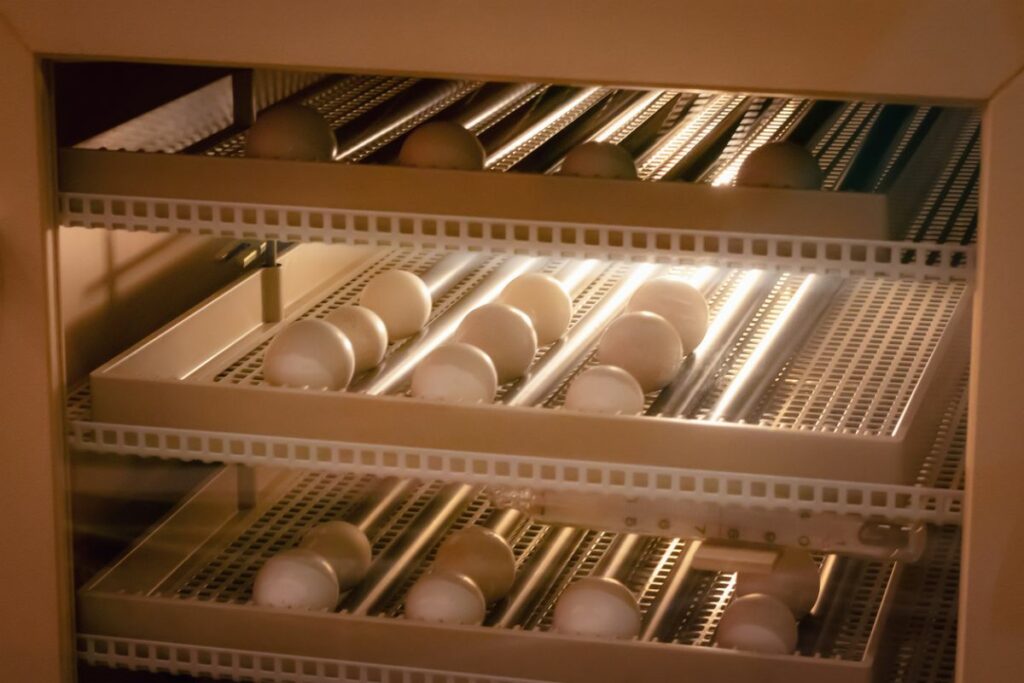
Turn according to a reliable protocol or the machine’s automatic system, checking that the mechanism actually moves. With manual turning, use clean hands and gentle handling; mark sides if that helps keep a record. Avoid unnecessary opening that destabilizes conditions.
Candling around the end of the first week can reveal developing vessels and an embryo, but visibility depends on shell color, equipment, and experience. A dark shell can be difficult to interpret. If uncertain, seek experienced help rather than discarding eggs because a quick look showed little detail. Remove cracked or leaking eggs safely.
Around day 18: prepare for hatch
Stop turning chicken eggs at the appropriate point, usually around day 18, and configure the hatching surface as the manual requires. Adjust humidity for hatch using the relevant protocol while maintaining ventilation. Humidity is not a substitute for oxygen, so do not close every vent to make the display rise.

Have the brooder ready before chicks arrive. Record any departure from normal conditions so it can be considered if hatch is early, late, or poor.
Pipping and hatch
A chick may make an opening and then rest while hatching progresses. Do not peel away shell or membrane simply because progress seems slow. Premature assistance can cause injury or bleeding, and a generic time limit cannot account for every situation. Ask an experienced poultry professional or veterinarian if intervention seems necessary.
Avoid repeatedly opening the incubator to count or handle wet chicks. Move dry chicks to the prepared brooder according to the machine’s guidance and the hatch situation. Provide starter feed and suitable water without delaying access unnecessarily.

If the hatch is late or incomplete
Review actual recorded conditions, not just the set-point: temperature accuracy, humidity, airflow, turning, egg age, transport, and fertility all matter. Mississippi State’s incubation guidance links common failures to those interacting factors. Day 21 is an expectation, not permission to open every remaining egg.
Keep a hatch record with eggs set, fertile development observed, chicks hatched, losses, and equipment changes. Use it to improve the next attempt rather than adjusting several settings at random during a hatch.